Publications
publications by categories in reversed chronological order.
2023
- NeurIPS 2023
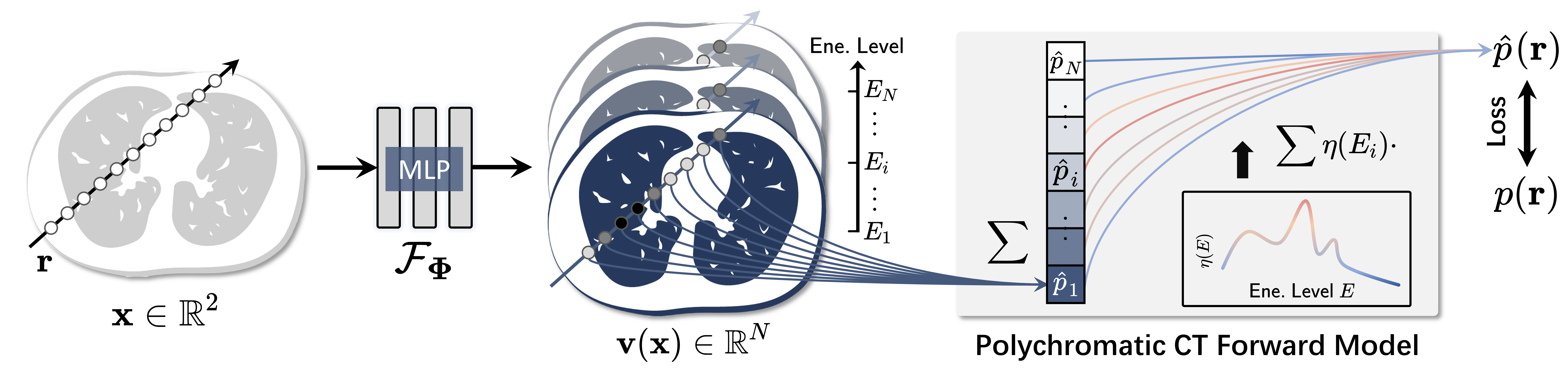
×Unsupervised Polychromatic Neural Representation for CT Metal Artifact ReductionQing Wu , Lixuan Chen , Ce Wang , Hongjiang Wei , S. Kevin Zhou , Jingyi Yu , Yuyao ZhangAdvances in Neural Information Processing Systems 2023Emerging neural reconstruction techniques based on tomography (e.g., NeRF, NeAT, and NeRP) have started showing unique capabilities in medical imaging. In this work, we present a novel Polychromatic neural representation (Polyner) to tackle the challenging problem of CT imaging when metallic implants exist within the human body. The artifacts arise from the drastic variation of metal’s attenuation coefficients at various energy levels of the X-ray spectrum, leading to a nonlinear metal effect in CT measurements. Reconstructing CT images from metal-affected measurements hence poses a complicated nonlinear inverse problem where empirical models adopted in previous metal artifact reduction (MAR) approaches lead to signal loss and strongly aliased reconstructions. Polyner instead models the MAR problem from a nonlinear inverse problem perspective. Specifically, we first derive a polychromatic forward model to accurately simulate the nonlinear CT acquisition process. Then, we incorporate our forward model into the implicit neural representation to accomplish reconstruction. Lastly, we adopt a regularizer to preserve the physical properties of the CT images across different energy levels while effectively constraining the solution space. Our Polyner is an unsupervised method and does not require any external training data. Experimenting with multiple datasets shows that our Polyner achieves comparable or better performance than supervised methods on in-domain datasets while demonstrating significant performance improvements on out-of-domain datasets. To the best of our knowledge, our Polyner is the first unsupervised MAR method that outperforms its supervised counterparts.
- IEEE ISBI 2023
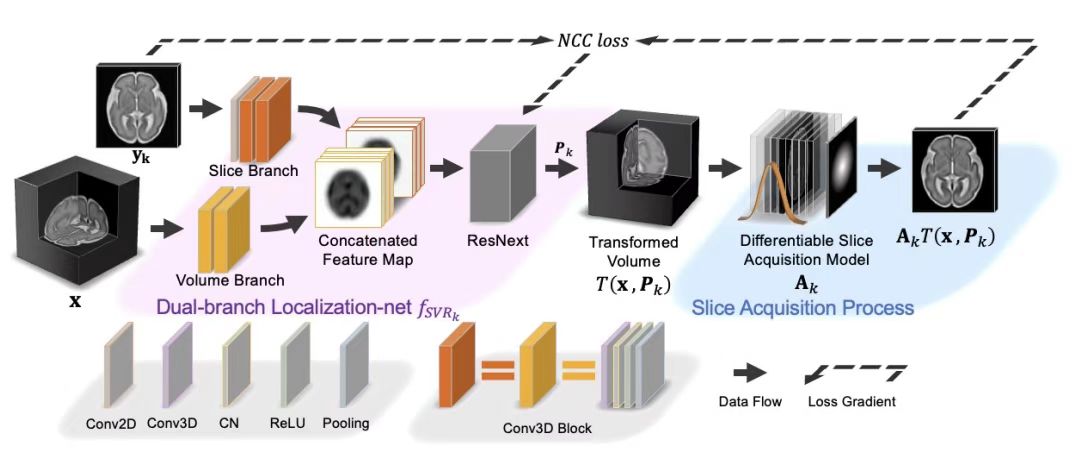
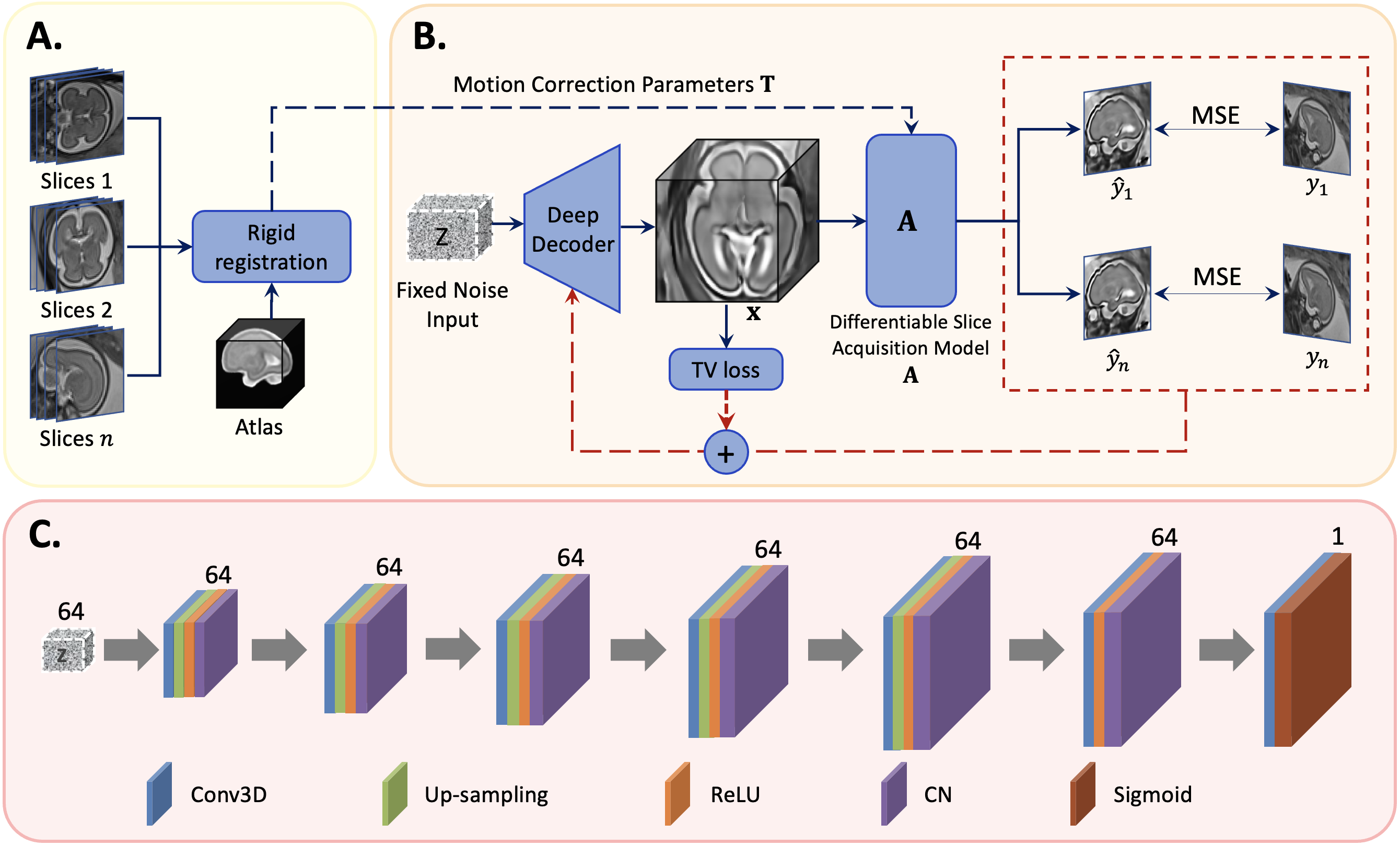
×ASSURED: A Self-supervised Deep Decoder Network for Fetus Brain MRI ReconstructionJiangjie Wu , Lixuan Chen , Zhenghao Li , Rongpin Wang , Hongjiang Wei , Yuyao Zhang20th IEEE International Symposium on Biomedical ImagingHigh-resolution Magnetic Resonance Imaging (MRI) volume reconstruction from multiple arbitrary orientation motion-corrupted 2D slices is crucial for fetal brain MRI studies. Currently, most existing methods follow two-step approaches that iteratively perform slice to volume registration (SVR) and super-resolution reconstruction (SRR). However, the 3D volume reconstruction is often corrupted due to slice misalignment and brain anatomy blurring caused by severe motion during MR data collection, making the quantification challenging. To tackle these issues, we propose a novel learning-based self-supervised volume reconstruction technique that is robust to slice misalignment and motion artifacts. Specially, we combine a comprehensive forward model to present the complex image degradation process and an under-parameterized deep decoder structure to reduce the network overfitting with image artifacts caused by slice misalignment and motion. This methodology requires only one coarse SVR step in the whole reconstruction process and does not need any training dataset in SRR. We evaluated the performance of our technique on simulated MRI from brain atlas and on real clinical scanning fetus MR data. Experimental results demonstrated that the proposed approach achieved superior fetus brain reconstruction results compared with state-of-the-art methods
2022
- PIPPI@ MICCAI 2022
Oral
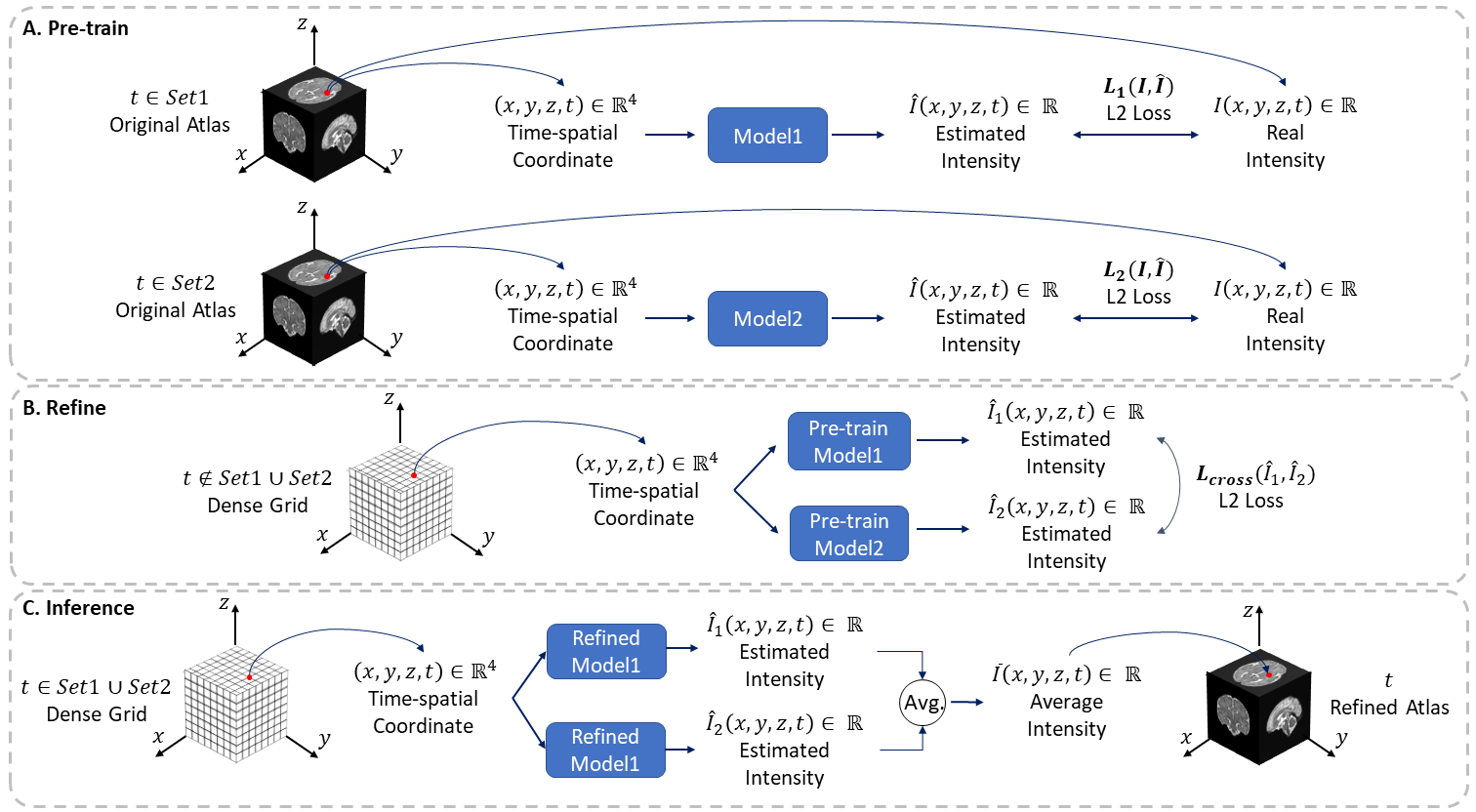
×Continuous longitudinal fetus brain atlas construction via implicit neural representationLixuan Chen , Jiangjie Wu , Qing Wu , Hongjiang Wei , Yuyao ZhangBest Paper Honorable MentionInternational Workshop on Preterm, Perinatal and Paediatric Image AnalysisLongitudinal fetal brain atlas is a powerful tool for understanding and characterizing the complex process of fetus brain development. Existing fetus brain atlases are typically constructed by averaged brain images on discrete time points independently over time. Due to the differences in onto-genetic trends among samples at different time points, the resulting atlases suffer from temporal inconsistency, which may lead to estimating error of the brain developmental characteristic parameters along the timeline. To this end, we proposed a multi-stage deep-learning framework to tackle the time inconsistency issue as a 4D (3D brain volume + 1D age) image data denoising task. Using implicit neural representation, we construct a continuous and noise-free longitudinal fetus brain atlas as a function of the 4D spatial-temporal coordinate. Experimental results on two public fetal brain atlases (CRL and FBA-Chinese atlases) show that the proposed method can significantly improve the atlas temporal consistency while maintaining good fetus brain structure representation. In addition, the continuous longitudinal fetus brain atlases can also be extensively applied to generate finer 4D atlases in both spatial and temporal resolution.